
Vaibhav Prashar Journey as a Digital Marketing Trainer – A Real Story of Learning, Failure, and Growth
Vaibhav prashar never planned to become a digital marketing trainer Like many people, my career started with doing what was available, not what was perfect. Vaibhav prashar worked in retail stores, customer service roles, and frontline operations. Those early years were tough. Long hours, pressure to meet targets, and constant interaction with customers taught me something very important early in life — communication and attitude matter more than titles This is where my journey truly began.
Learning from Retail Floors and Real People
Vaibhav Prashar first professional years were spent at places like Shoppers Stop and retail organizations, where I worked closely with customers every single day. I learned how people think, what makes them trust a brand, and how communication can either close a sale or break it.At that time, I didn’t know words like branding, funnels, or customer journey.But I was already living them.Those years gave me confidence, patience, and the ability to explain things simply — skills that later became my biggest strength as a trainer.
Moving into Training – Teaching Before Knowing Everything
My academic background in Hotel Management and Service Industry slowly pushed me towards training roles. I started working with IL&FS Institute of Skills, GMR Varalakshmi Foundation, and later NIIT Foundation. Most of my students came from challenging backgrounds. Many lacked confidence, English fluency, or career direction. Teaching them changed me. I realized that training is not about knowledge — it’s about empathy.
Discovering Digital Marketing (The Turning Point)
Digital marketing entered my life when I saw how fast the world was changing. Businesses were moving online. Jobs were changing. Students were confused. I felt the pressure myself — If I don’t upgrade, I’ll be left behind. So I started learning digital marketing and SEO from scratch: Reading Practising Failing Trying again SEO didn’t make sense at first. Rankings didn’t come. Results were slow. But over time, things clicked. I understood how search engines think, how content works, and how skills can create independence
Why I Teach Communication Along with Digital Marketing
This decision didn’t come from a curriculum plan.It came from watching people break silently in front of me. Over the years, I’ve trained students who were technically brilliant. They understood SEO concepts, could explain social media strategies on paper, and even executed campaigns during training. Yet, when it came to interviews, group discussions, or client conversations—they froze.I still remember one student clearly. He cleared the technical rounds for a digital marketing role. His SEO knowledge was strong. But during the HR round, he couldn’t frame simple sentences. His voice dropped, his confidence disappeared, and eventually, the opportunity slipped away. After the interview, he didn’t complain about the company. He blamed himself.That moment stayed with me.
About My Certifications
My certifications represent more than formal credentials—they reflect practical expertise, industry alignment, and a commitment to continuous professional growth. Each certification has strengthened my ability to deliver high-impact training in retail, digital marketing, AI skills, and soft skills, aligned with national skill standards and real-world industry requirements.
Certified ToT Trainer – Retail (RASCI)
(Retailers Association’s Sector Skill Council of India)
This Training of Trainers (ToT) certification validates my expertise in retail operations, customer service, sales processes, and store management. It equips me to train learners according to industry-approved competency frameworks, ensuring employability-focused outcomes.
Through this certification, I gained advanced knowledge in:
-
Retail sales techniques and customer handling
-
Store operations and inventory basics
-
Training delivery methodologies for adult learners
-
Assessment and evaluation standards
This credential enables me to design and deliver structured, job-oriented retail training programs for students and working professionals.
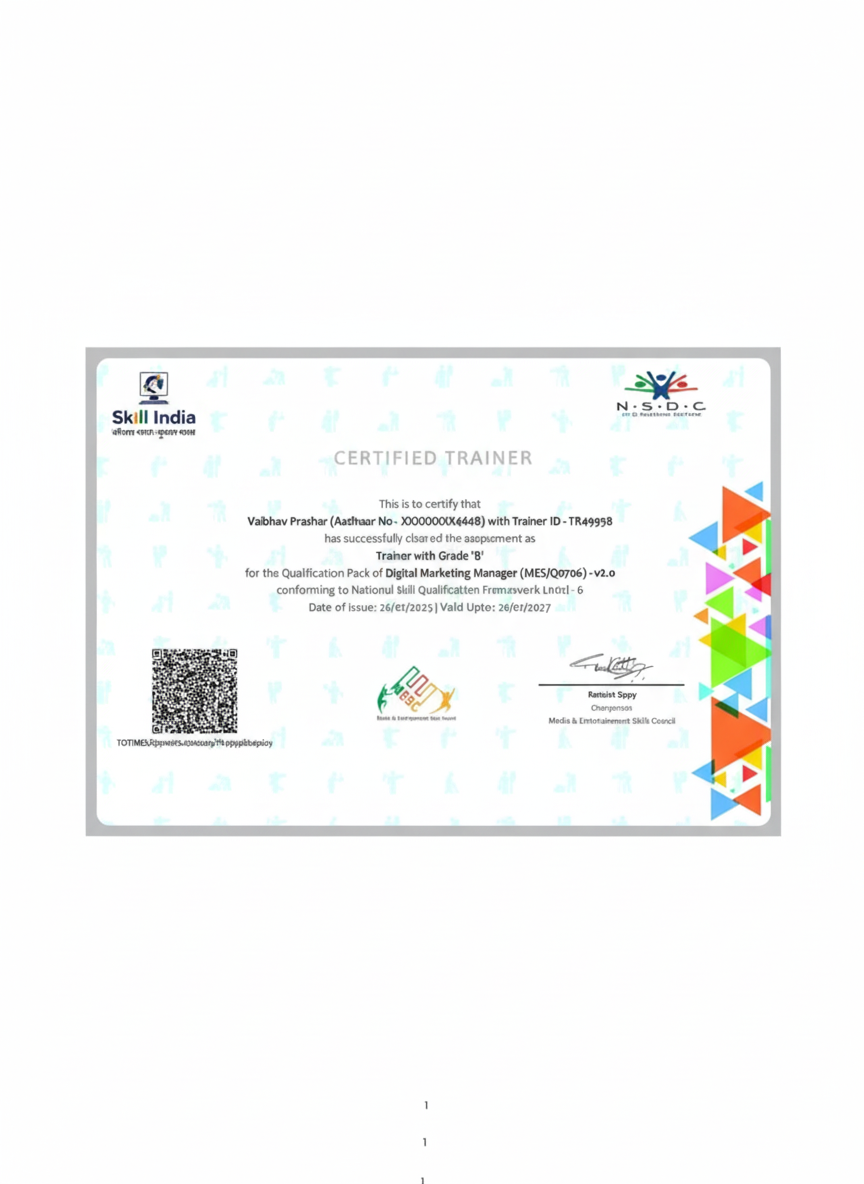
Certified ToT Trainer – Digital Marketing (MESC)
(Media & Entertainment Skills Council)
This nationally recognized certification confirms my capability to train individuals in digital marketing fundamentals and advanced concepts, aligned with current industry needs.
It strengthened my expertise in:
-
SEO and digital content strategies
-
Social media marketing fundamentals
-
Digital tools and campaign planning
-
Industry-aligned training delivery
As a certified ToT trainer, I focus on practical learning, live examples, and skill-based outcomes, helping learners build confidence and job-ready digital skills.
O Level Certification in Information Technology – NIELIT
(National Institute of Electronics & Information Technology)
The O Level IT certification provided a strong technical foundation, enabling me to integrate technology effectively into training and digital marketing workflows.
Key areas covered include:
-
Computer fundamentals and IT applications
-
Digital systems and data handling
-
Practical use of technology in professional environments
This certification supports my ability to train learners in technology-enabled learning, digital tools, and AI-assisted workflows.
Retail & Inventory Management – NIIT Foundation
This certification enhanced my understanding of retail inventory control, supply chain basics, and store efficiency, which is critical for frontline retail and operations training.
It supports my training in:
-
Inventory planning and stock management
-
Retail process optimization
-
Sales planning and operational efficiency
Child Psychology – Planet Spark
This certification added an important psychological dimension to my teaching and training approach. Understanding how learners think, behave, and respond has helped me become a more empathetic and effective trainer.
It helps me:
-
Adapt teaching methods to learner needs
-
Improve engagement and motivation
-
Create supportive and confidence-building learning environments
Why These Certifications Matter
Together, these certifications allow me to:
-
Deliver industry-relevant, outcome-driven training
-
Align teaching with national skill standards
-
Combine AI, digital tools, and human-centered learning
-
Train students, job seekers, and professionals effectively
They reinforce my role as a Certified Retail, Digital Marketing & AI Skills Trainer with a strong balance of technical knowledge, communication skills, and real-world experience.
Certified ToT Trainer
Digital Marketing Trainer Certification
Retail Training Certification
AI Skills Trainer
NIELIT O Level Certification
Skill Development Trainer India
Confidence Is the Real Missing Skill
Most students don’t lack intelligence.
They lack confidence in their own voice.
Many come from backgrounds where:
1.English was never spoken at home
Knowledge Is Not Enough If You Cannot Express It
Digital marketing is not a silent profession. It speaks every single day—through reports, meetings, content, and conversations. You are constantly expected to explain SEO results to clients who don’t understand technical terms, pitch strategies to managers who care about outcomes, and write content that doesn’t just inform but convinces people to act. You have to sit in interviews and speak with confidence about your skills, your decisions, and your value. And beyond all this, you must learn how to handle rejection, feedback, and pressure without losing belief in yourself.
I’ve seen students who knew everything but couldn’t say anything. Their knowledge stayed locked inside them. And I’ve also seen average-skilled students get selected—not because they were better technically, but because they could express their thoughts clearly and confidently. They were heard. They were understood. They were trusted.
That’s when I realised something that shaped my entire training approach: digital marketing skills may open doors, but communication skills are what help you walk through them and stay inside with confidence.
Why Basic to Advanced English Communication Is Non-Negotiable in My Training
That’s why I don’t teach digital marketing alone anymore.
My training always includes:
Basic English communication for beginners
-
Sentence formation and daily speaking practice
-
Interview-oriented communication
-
Presentation and professional speaking skills
-
Confidence-building exercises
I don’t correct students harshly. I let them speak. I let them fail safely. I help them find their voice.
Because confidence doesn’t come from perfection.
It comes from practice without fear.
And that moment—when a student speaks without hesitation for the first time—is something I never take lightly.
I’ve seen learners surprise themselves. Students who once avoided introductions begin volunteering to speak. Those who sat quietly at the back start asking questions. Not because they suddenly learned better English, but because they finally felt safe enough to be heard. That safety changes everything. It creates belief. And belief creates momentum.
Once confidence enters the room, learning accelerates. Digital marketing concepts start making more sense. Students ask better questions, share ideas freely, and take ownership of their growth. They stop memorising and start understanding. They stop hiding and start participating.
That is why communication is not an “extra” in my training. It is the foundation. Digital marketing tools will change, algorithms will update, and platforms will evolve—but the ability to express ideas clearly and confidently will always remain relevant.
When students leave my classroom, I don’t just want them to know digital marketing. I want them to trust their voice, speak with clarity, and walk into opportunities without shrinking themselves.
Because skills can be taught in many places.
Digital Marketing Without Communication Has a Ceiling
You can learn all the tools:
-
SEO
-
AI tools
-
Ads and analytics
But without communication:
-
You won’t grow into leadership roles
-
You’ll struggle with clients
-
You’ll hesitate to freelance
-
You’ll doubt yourself
I don’t want my students to stop at execution roles.
I want them to grow, lead, and speak with confidence.
This Is Personal for Me
I’ve walked this path myself.
I’ve faced moments where I had skills but doubted my expression. I’ve seen how communication can change the way people treat you, trust you, and value you.
That’s why teaching communication is not an add-on for me.
It’s a responsibility.
Final Thought
If I had to summarise my philosophy in one line, it would be this:
Skills give you opportunity.
Communication gives you dignity.
Why I Teach Communication Along with Digital Marketing
Here’s one more real, emotional story, written in the same human tone, centred on Muskan, without sounding scripted or artificial. You can place it right after the previous paragraph.
I remember Muskan.
She was one of the most sincere learners I had trained. Her understanding of digital marketing fundamentals was sharp. She grasped SEO basics quickly, wrote decent content, and could analyze social media campaigns better than many others in the batch. On paper, she was “ready”.
But whenever it was her turn to speak, something changed.
During mock interviews, her answers were correct—but her voice wasn’t steady. She avoided eye contact. She rushed through sentences, afraid of being judged for her English. Once, after a session, she stayed back and quietly said, “Sir, I know the answer… but my words don’t come out properly.”
That line hit me harder than any feedback ever could.
Later, she faced a real interview. Technically, she did well. The interviewer even nodded while she explained SEO concepts. But when asked to introduce herself confidently and explain her role expectations, she hesitated. Her confidence cracked. She walked out knowing she hadn’t shown her true potential.
She didn’t fail because she lacked knowledge.
She failed because she didn’t trust her own voice.
That day, I realised something very clearly—how many talented people lose opportunities not because they are incapable, but because they are unheard.
Muskan eventually worked on her communication. Slowly. Patiently. Sentence by sentence. Today, she speaks with clarity and confidence. Not perfect English—but honest, fearless expression. And that made all the difference.
Stories like hers remind me why I can never separate communication skills from digital marketing training.
Because skills can be taught.
But confidence must be nurtured.
And silence should never be the reason someone’s talent goes unnoticed.
Why Communication Became an Essential Part of My Digital Marketing Training
Digital marketing is not a silent profession. It speaks every single day—through reports, meetings, content, and conversations. You are constantly expected to explain SEO results to clients who don’t understand technical terms, pitch strategies to managers who care about outcomes, and write content that doesn’t just inform but convinces people to act. You have to sit in interviews and speak with confidence about your skills, your decisions, and your value. And beyond all this, you must learn how to handle rejection, feedback, and pressure without losing belief in yourself.
I’ve seen students who knew everything but couldn’t say anything. Their knowledge stayed locked inside them. And I’ve also seen average-skilled students get selected—not because they were better technically, but because they could express their thoughts clearly and confidently. They were heard. They were understood. They were trusted.
That’s when I realised something that shaped my entire training approach: digital marketing skills may open doors, but communication skills are what help you walk through them and stay inside with confidence.
Final Thoughts
Over the years, I’ve learned that teaching is not only about skills. It’s about people. Every student who stayed silent in class, every learner who lost confidence after an interview, and every moment of self-doubt I’ve seen has changed the way I teach.
Digital marketing tools will keep changing. New platforms will come and go. But one thing will always matter—being able to speak clearly and believe in yourself. When students gain confidence, their skills finally start working for them.
I don’t judge success only by jobs or certificates. I value the small moments—when a student raises their hand, speaks without fear, or finally believes they are capable.
If there is one thing I truly believe, it is this:
Skills can open doors, but confidence helps you walk through them.
If my training helps someone speak with courage and trust their own voice, then this journey is worth everything.